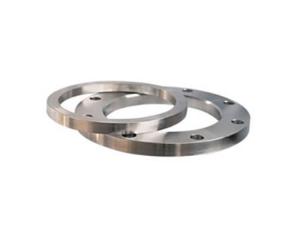
Every other flange type carries its joint in a forged hub or neck. A plate flange carries it in the plate itself: the ring is cut and machined from flat plate, slipped over the pipe, and fillet welded — or left loose to work as a backing ring. Without a hub to taper stress into the pipe, plate flanges are light-duty flanges, and within that duty they are unbeatable on cost, weight and simplicity.
Two uses dominate. As a fixed flange, the plate ring is welded to the pipe end for low-pressure, low-temperature lines. As a loose flange, the ring stays un-welded and bears against a stub end or a flared pipe end — the loose plate category named in the official classification.
| Item | Range / Options |
|---|---|
| Types | Loose plate flanges (official classification); carbon steel plate flange named in catalogue listing titles |
| Standards | Confirmed per product at enquiry — state the pattern your specification calls up |
| Size range | Confirmed per product at enquiry |
| Pressure classes | Confirmed per product at enquiry — plate flanges are a low-class product by construction |
| Faces | Confirmed per product at enquiry — flat face is the common form for plate rings |
| Materials | Carbon steel, as named in the catalogue listing titles for the plate flange; no grade is stated for a plate execution in the catalogue records — the grade for a specific product is confirmed at enquiry |
Plate Flange or Lap Joint Flange?
The two are cousins, and the ranges on this site divide them by the job each page covers. The lap joint page covers the loose backing flange as one half of a system: it works with a welded stub end, which provides the sealing face in the pipe material while the flange only clamps. This page covers the plate flange as a flange type in its own right — the flat plate ring itself, whether it is fillet welded to the pipe as the line's own flange or used loose as a back ring. If your drawing shows a stub end, you are in lap joint territory; if it shows a plate ring welded to the pipe, or a plate ring alone, this is the page.
Plate Flange or Slip-On?
A slip-on flange is a forging with a raised hub face and a machined bore step; a plate flange is flat plate with no hub at all. The slip-on's forging gives it the full class rating of its standard tables. The plate flange trades that rating away for economy in services that never approach it — water, air, ventilation, tank and low-pressure utility connections.
Where Plate Flanges Belong
Low-pressure water and air lines, tank nozzles and equipment connections at modest classes, galvanised and coated systems where the ring is used loose, and backing-ring duty behind stub ends and flared ends. They are not for high classes, severe cycling or hazardous media — those belong to the forged types in the flange range.
Ordering
State NPS, the class or pattern, the bore (the pipe outside diameter the ring must clear, or the stub end it must back), the facing if any, and the grade. Note whether the ring is to be welded to the pipe or supplied loose — it changes the bore fit that matters.
Frequently Asked Questions
Is a plate flange the same as a lap joint flange?
They overlap in the loose use, but they are not the same product definition. A lap joint flange is the backing half of the stub end system, dimensioned to bear on the stub end's flare. A plate flange is a flat plate ring in its own right — welded to the pipe as a fixed flange, or used loose. The classification names loose plate flanges as their own category; which product your joint needs follows from the drawing.
Can plate flanges be used at high pressure?
By construction, no — the flat ring has no hub to carry stress into the pipe, so plate flanges are a low-class product. For higher classes use a forged type: weld neck for serious duty, slip-on for economy within its rating. The class for a specific plate flange is confirmed at enquiry.
What grades do carbon steel plate flanges come in?
No plate flange execution with a stated grade is among the catalogue executions referenced on this site — the grades named in the weld neck listing titles (A105, S235JR, S275JR) belong to those listings, not to the plate flange. State the grade your specification names on the enquiry and it will be confirmed for the specific product before order.
Do plate flanges need a machined facing?
Flat face is the common form, used with full-face gaskets. If your joint needs a raised face or a specific finish, state it on the enquiry and it will be confirmed for the specific product.
Related Products
Send Your Specification
Tell us the size, schedule or pressure class, material grade and quantity for the plate flanges you need. MOQ and lead time are confirmed in the quotation for your exact specification.