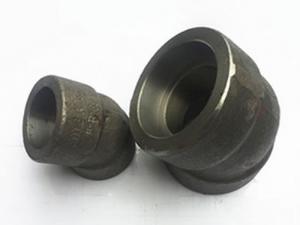
The problem an outlet solves is reinforcement. Cutting a branch hole in a header removes pressure-bearing metal, and the piping codes require that metal to be replaced around the opening. A tee replaces it with a full fitting. A branch outlet replaces it inside its own forging: the base is thickened and contoured to the header's outside diameter, the branch rises from the reinforcement, and the whole piece is welded to the run pipe in one operation.
The governing standard for the type, as standard knowledge, is MSS SP-97, which covers integrally reinforced forged branch outlet fittings. The standard for a specific product is confirmed at enquiry.
| Item | Range / Options |
|---|---|
| Types | Branch outlet fittings — named as Outlets in the supplier's official classification of forged fitting types |
| Standards | MSS SP-97 covers integrally reinforced forged branch outlet fittings (standard knowledge); the standard for a specific product is confirmed at enquiry |
| Run / branch sizes | Confirmed per product at enquiry — state both the header size and the branch size |
| Pressure basis | Confirmed per product at enquiry — state the branch schedule or class basis with the enquiry |
| Ends | Confirmed per product at enquiry — state the branch connection your line uses |
| Materials | Confirmed per product at enquiry — state the grade your specification names |
How an Outlet Works
The outlet is a forging, not a fabrication. Its underside is machined to the curvature of the header it will sit on, so the weld groove follows the run pipe's surface; the branch bore is machined to the branch pipe's inside diameter; and the metal between base and branch is the reinforcement the code calculation requires, supplied integrally rather than as a separate pad. The header is cut with a hole inside the outlet's footprint, the outlet is welded around its base contour, and the branch pipe is joined to the outlet's branch end.
The Three Branch Connections
As standard knowledge of the MSS SP-97 system, branch outlets are made with three branch connections: a butt weld end (the form generically called a weldolet), a socket weld end (a sockolet), and a threaded end (a thredolet). Those names describe end types in the standard's system. None of the three is one of the catalogue executions referenced on this site: name the connection your line uses on the enquiry, and the execution will be assessed for the specific product before order.
Outlet, Tee or Saddle?
Three ways to branch a line, three different constructions. A butt weld tee is a complete fitting inserted in the run — the run is cut and the tee welded in at both run ends and the branch. A branch outlet is welded onto the outside of an uncut header, which is why outlets are the choice for branches added to existing headers and for small branches on large runs. A butt weld saddle is the butt weld family's own branch form — a contoured plate-like branch piece rather than an integral forged reinforcement. The three are specified differently, so name the construction your drawing shows.
Specifying an Outlet
An outlet is defined by five things: the header (run) size and wall, the branch size, the branch wall or class basis, the branch connection type, and the material grade. The run size matters as much as the branch — the base contour is machined for one header diameter. Send those five items and the requirement will be assessed for the specific product and quoted on that basis.
Frequently Asked Questions
Do you supply weldolets?
Outlets are named in the supplier's official classification of forged fitting types, and the weldolet is the butt weld form of the type. No outlet execution is among the catalogue executions referenced on this site, so name the run and branch sizes, the class basis and the grade on your enquiry and the execution will be assessed for the specific product before order.
What sizes do branch outlets come in?
As a type, outlets serve small branches on larger headers — the branch is smaller than the run, and equal-size branches are normally tees. The run and branch combination for a specific product is confirmed at enquiry; state both sizes and both walls.
Can an outlet be added to a header that is already fabricated?
That is one of the type's main uses: the outlet welds to the outside of the run pipe, so the header does not have to be cut apart as it would for a tee. Whether a particular header can take the branch is a design check on your side — the outlet itself is assessed against your sizes and grade at enquiry.
What is the difference between an outlet and a reinforcing pad?
A reinforcing pad is a separate plate that reinforces a branch made by welding a pipe stub directly to the header. A branch outlet forging carries its reinforcement integrally, with a machined branch bore and a contoured base, in one piece.
Related Products
All Forged Fittings
The forged family — catalogue executions: a socket weld elbow and an NPT plug in A105.
Send Your Specification
Tell us the size, schedule or pressure class, material grade and quantity for the forged fittings you need. MOQ and lead time are confirmed in the quotation for your exact specification.