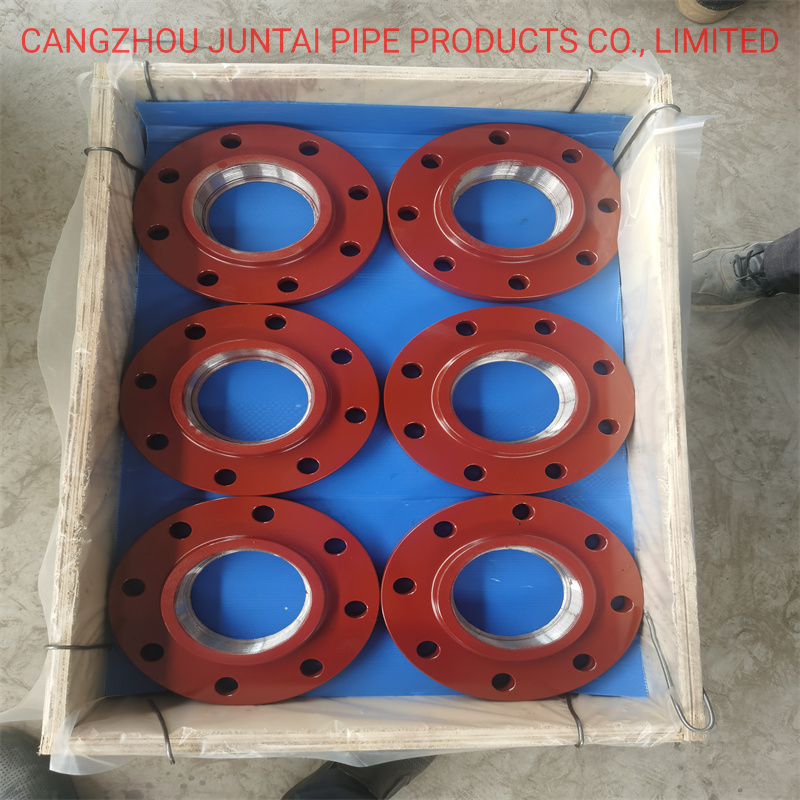
The slip-on's bore is slightly larger than the pipe outside diameter, so the flange slips over the pipe and sits where the fitter puts it; two fillet welds — one at the hub face, one inside the bore at the pipe end — fix it. There is no bevel to prepare and no bore to match to a schedule, which is the source of both its economy and its limits: the fillet-welded joint is not a full-strength butt weld, and the flange is not the choice for severe cyclic or high-pressure duty.
The catalogue executions sit in two standard systems: a slip-on in A105, Class 300, raised face — and JIS 5K / 10K patterns, where the catalogue lists slip-ons in A350 LF2 with test certificates for low-temperature service, a combination specified on Japanese-standard plant. The governing standard for a specific execution is confirmed against your enquiry; further sizes and classes are confirmed per product at enquiry.
| Item | Range / Options |
|---|---|
| Standards | Confirmed per product at enquiry — catalogue executions: an A105 Class 300 RF slip-on, and JIS 5K / 10K slip-ons |
| Size range | Confirmed per product at enquiry — JIS catalogue sizes include 1/2 inch (10K), 1-1/4 inch (10K) and 1-1/2 inch (5K) executions |
| Pressure classes | Class 300 (A105 catalogue execution); 5K / 10K (JIS catalogue executions); further classes confirmed per product at enquiry |
| Faces | Raised face (RF) in the A105 catalogue execution; other facings confirmed per product at enquiry |
| Materials | ASTM A105 (Class 300 catalogue execution); ASTM A350 LF2 on the 1/2 inch JIS 10K and 1-1/2 inch JIS 5K executions (low temperature, with test certificates); further grades confirmed per product at enquiry |
| Welding | Double fillet weld — hub and bore — as standard practice |
Where Slip-Ons Belong
Water, air, low-pressure steam tracing, cooling and utility systems, and secondary lines where the joint will not see severe pressure cycling or bending. Slip-ons are also common where a line must be assembled quickly and cut-to-fit on site, because the flange tolerates pipe length variation better than a weld neck.
Where They Do Not
High classes, sour or lethal service, heavy vibration, and lines under significant bending loads belong to weld neck flanges. The cost difference between the two types is small against the cost of a failed joint; choose by service, not by habit. The detailed comparison is in our weld neck vs slip-on guide.
Low-Temperature JIS Executions
The catalogue's JIS 5K and 10K slip-on listings in A350 LF2, with test certificates for low-temperature service, exist because Japanese-standard plants in cold service need exactly that paperwork trail. If your specification is JIS-based, state the JIS class and the certificate requirement on the enquiry.
Frequently Asked Questions
Does a slip-on flange need the pipe schedule?
No — the bore clears the pipe outside diameter and the joint is fillet welded, so no schedule-matched bore is machined. You still need NPS, class, facing and grade to define the flange.
Are slip-on flanges weaker than weld neck flanges?
The joint is different, not simply weaker: under internal pressure both types are rated by the same class tables, but under cyclic load the slip-on's fillet-welded joint has lower fatigue performance than the weld neck's butt-welded joint — which is why standards and specs restrict slip-ons by class and service rather than banning them.
Can slip-ons be used in stainless steel?
No stainless slip-on execution is among the catalogue executions referenced on this site; name the grade on the enquiry and it will be assessed for the specific product before order. On stainless lines many buyers instead choose the stub end and lap joint system, which keeps the expensive grade only where it is needed — see lap joint flanges.
Related Products
Send Your Specification
Tell us the size, schedule or pressure class, material grade and quantity for the slip-on flanges you need. MOQ and lead time are confirmed in the quotation for your exact specification.